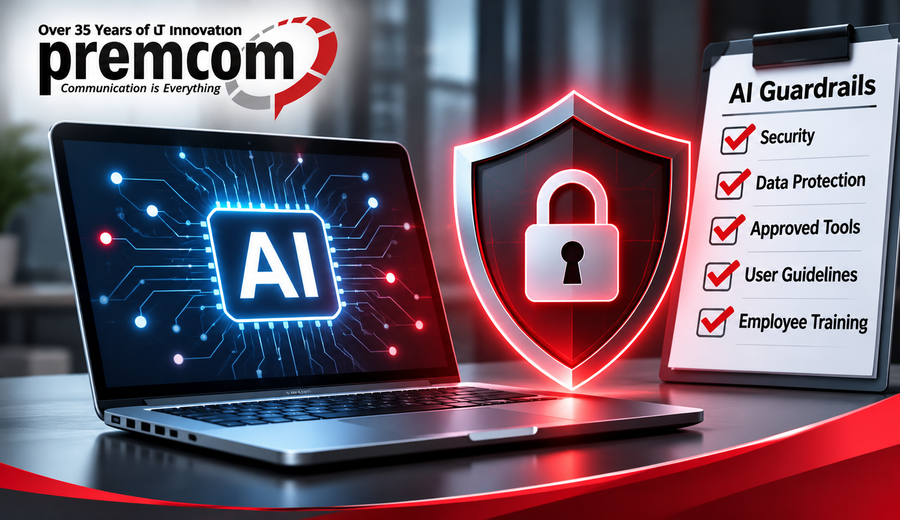
Artificial intelligence is rapidly changing how businesses operate. From drafting emails and analyzing information to streamlining workflows and improving customer service, AI tools are becoming part of everyday business operations.
But the next evolution of AI introduces a new consideration for business leaders: AI agents that don't just provide answers—they take action.
Unlike traditional AI assistants that respond to questions or generate content, AI agents can be given the ability to access business applications, retrieve information, interact with other systems, and independently execute tasks. Depending on their permissions, they may be able to send communications, update records, run code, initiate transactions, or make decisions with limited human involvement.
The productivity opportunities are significant. So are the security and governance challenges.
New research from Ernst & Young (EY) suggests that organizations may be moving faster with AI adoption than their ability to manage the associated risks. For business leaders, this raises an important question: Does your organization know what its AI systems can access, what they are authorized to do, and how to keep those activities under control?
AI Is Moving From Assistant to Autonomous Agent
Most businesses are already familiar with AI tools that help employees work more efficiently. An employee might use AI to summarize a document, draft a proposal, research a topic, or organize information.
AI agents take those capabilities a step further.
Rather than simply recommending what someone should do, an AI agent can be assigned a goal and the ability to complete a series of tasks to achieve it. It may connect to multiple business applications, retrieve company data, communicate with other systems, and execute actions with minimal human intervention.
For example, an AI agent might:
- Review incoming customer inquiries and prepare or send responses.
- Retrieve information from internal databases and generate reports.
- Update customer records in a CRM system.
- Coordinate tasks across multiple business applications.
- Analyze invoices and initiate approval workflows.
- Monitor security events and help trigger incident response activities.
These capabilities can reduce repetitive work, improve efficiency, and allow employees to focus on higher-value responsibilities.
However, every additional capability introduces another consideration: access, authority, and accountability.
An AI agent with permission to read information is different from one that can modify records, send external communications, or initiate financial transactions. The more authority an organization gives an AI agent, the more important it becomes to understand and manage its activities.
What EY's Latest Research Reveals About AI Governance
A September 2026 study from Ernst & Young (EY) provides an important look at the challenges organizations are facing as AI adoption accelerates.
EY's inaugural U.S. AI Risk and Governance Survey included 202 senior AI decision-makers, including board members, C-suite executives, and senior vice presidents at publicly traded U.S. companies generating at least $1 billion in annual revenue.
The findings reveal a significant gap between having AI governance policies and effectively enforcing them.
Consider these results:
98% of respondents said their organizations have formal AI governance policies in place.
That sounds encouraging. However, the research uncovered a very different picture when EY examined how those policies were being implemented.
47% acknowledged that their organizations had previously bypassed their own AI governance processes for urgent deployments.
In other words, even organizations with formal policies sometimes set those policies aside when moving quickly becomes a priority.
The findings become even more concerning when looking specifically at AI agents:
- 91% of respondents said their organizations were using agentic AI, either through pilot programs or enterprise deployment.
- 85% of respondents at organizations using agentic AI said at least some of their agents were executing activities without real-time human involvement.
- 49% said their existing AI governance frameworks had not been specifically updated to address the risks and requirements of agentic AI.
- 26% said their organizations could not detect unauthorized AI agents operating internally.
There is another important finding: 36% of respondents reported that their organizations had experienced an AI incident or failure resulting in a materially negative impact, including data loss, financial damage, brand damage, or operational disruption.
These findings demonstrate that AI governance is not simply a matter of establishing policies. Organizations must also ensure those policies are implemented, monitored, and adapted as technology evolves.
For business leaders, the message is clear: adopting AI without adequate visibility and oversight can introduce risks that are difficult to identify until something goes wrong.
Source: EY – AI Governance Has Entered Its Next Phase: Closing the Confidence Gap, September 15, 2026.
Five AI Agent Security Risks Business Leaders Should Understand
As organizations give AI agents greater access to their systems and information, several security concerns deserve attention.
1. Excessive Access to Sensitive Business Information
An AI agent can only perform the tasks it is authorized to perform, but those permissions may be broader than necessary.
If an agent has access to shared files, customer information, financial records, email, or other sensitive business data, a configuration mistake or compromised integration could expose information that should remain restricted.
Businesses should follow the principle of least privilege: give each AI agent access only to the specific information and systems it needs to perform its assigned responsibilities.
2. Unauthorized or Unintended Actions
An AI agent may be designed to complete a task, but that doesn't mean every action it takes will be appropriate.
A poorly configured agent could modify records, send communications, initiate transactions, or trigger workflows in ways that were never intended.
The concern becomes greater when agents are allowed to make changes across multiple applications without human review.
Businesses should establish clear boundaries around what AI agents can do independently and which activities require human approval.
3. Prompt Injection and AI Manipulation
AI agents can encounter instructions within emails, documents, websites, and other content they process.
Some of that information may contain malicious instructions designed to manipulate an AI system into revealing sensitive information, ignoring its intended safeguards, or taking an unauthorized action.
This type of attack, known as prompt injection, is particularly important when an AI agent can access company data or interact with external systems.
Organizations need to recognize that information an AI agent encounters cannot automatically be trusted. Security controls should limit what an agent can do and prevent untrusted instructions from overriding its intended purpose.
4. Shadow AI: The Technology IT Doesn't Know About
Employees often adopt new technology because it makes their jobs easier. AI is no exception.
An employee may create an AI agent, connect an outside application to company data, or begin using an automated service without involving the IT department.
This creates what is commonly called Shadow AI.
When IT teams don't know which AI tools and agents are operating within the organization, they cannot effectively evaluate their permissions, monitor their activity, or determine whether company information is being handled appropriately.
Visibility is the first step toward managing this risk.
5. Unclear Accountability and Oversight
When an employee takes an action, there is generally an identifiable person responsible for it. With autonomous AI agents, accountability can become less clear.
Who approved the agent? Who determines what it can access? Who reviews its activity? And who is responsible if it makes an incorrect decision or exposes sensitive information?
Every AI agent should have a defined business purpose, an accountable owner, and clear boundaries for what it is permitted to do.
AI can perform tasks, but responsibility for business decisions and outcomes must remain with people.
Five Steps Business Leaders Should Take Before Expanding AI Use
Businesses don't need to avoid AI agents. They need to adopt them responsibly.
Here are five practical steps organizations can take to balance productivity with security.
1. Know Which AI Tools and Agents Are Being Used
Start by identifying the AI applications, agents, and automated integrations currently operating within the organization. Include tools employees may have adopted independently, not just those formally approved by management.
Maintain an inventory that identifies each agent, its business purpose, its owner, the systems it can access, and the actions it is authorized to perform.
2. Establish an AI Acceptable-Use Policy
Define which AI tools employees may use, what information can be shared, and which activities require approval.
Employees should understand that convenience cannot come at the expense of protecting company information. Policies should also address how AI agents are created, approved, deployed, and monitored.
3. Limit Permissions and Access
Apply least-privilege access controls. Each agent should have its own appropriately scoped permissions rather than automatically inheriting broad access to an employee's accounts, files, or applications.
Review permissions regularly, particularly when an agent's responsibilities change or it is connected to additional systems.
4. Monitor Activity and Require Human Oversight
Maintain visibility into what agents are accessing and what actions they are performing.
Establish approval requirements for sensitive activities such as financial transactions, changes to important business records, access to confidential information, and external communications.
Organizations should also maintain activity logs and establish procedures for quickly disabling an agent if it behaves unexpectedly.
5. Evaluate AI Security Before Expanding Automation
Before connecting AI agents to critical business systems, evaluate the security of the underlying infrastructure, applications, identities, and integrations.
Review third-party AI providers, understand where company information is being processed, and ensure that monitoring and incident response procedures account for AI-related activity.
AI security should be part of the organization's broader cybersecurity strategy, not an afterthought.
AI Innovation Requires More Than Technology. It Requires Oversight.
The rapid advancement of AI creates tremendous opportunities for businesses to improve productivity, streamline operations, and gain a competitive advantage.
But the EY research highlights an important challenge: even organizations with established governance policies are struggling to keep pace with the technology they are deploying.
The National Institute of Standards and Technology (NIST) offers an additional resource for organizations working to address these challenges. Its AI Risk Management Framework and companion Generative AI Profile provide guidance for identifying, evaluating, and managing AI risks throughout the technology lifecycle. The framework emphasizes clear responsibilities, appropriate human oversight, ongoing monitoring, and documented risk management practices.
Businesses don't need to develop every safeguard from scratch. They can use established guidance to build a more structured approach to AI adoption.
Ultimately, the question for business leaders is no longer simply whether their organization should use AI. It is whether they understand what their AI tools are authorized to access, what they are capable of doing, and who is accountable for their actions.
As AI becomes more deeply integrated into business operations, cybersecurity strategies must evolve alongside it. Strong access controls, continuous monitoring, employee education, and proactive IT management will be essential to adopting these technologies safely.
At PremCom, we believe technology should empower businesses—not introduce unnecessary risk. Having the right IT infrastructure, security controls, and expert guidance in place helps organizations embrace innovation while protecting the people, systems, and information that keep their businesses running.
Before giving AI more control, make sure you know who—or what—you're giving access to.
Ready to evaluate your organization's technology and cybersecurity posture? Contact PremCom at sales@premcom.com to start the conversation.
Stronger IT infrastructure. Smarter security.